
Artburst Extras
In ‘Vigil,’ Ana Mosquera Redraws the Systems That Decide Who We Are
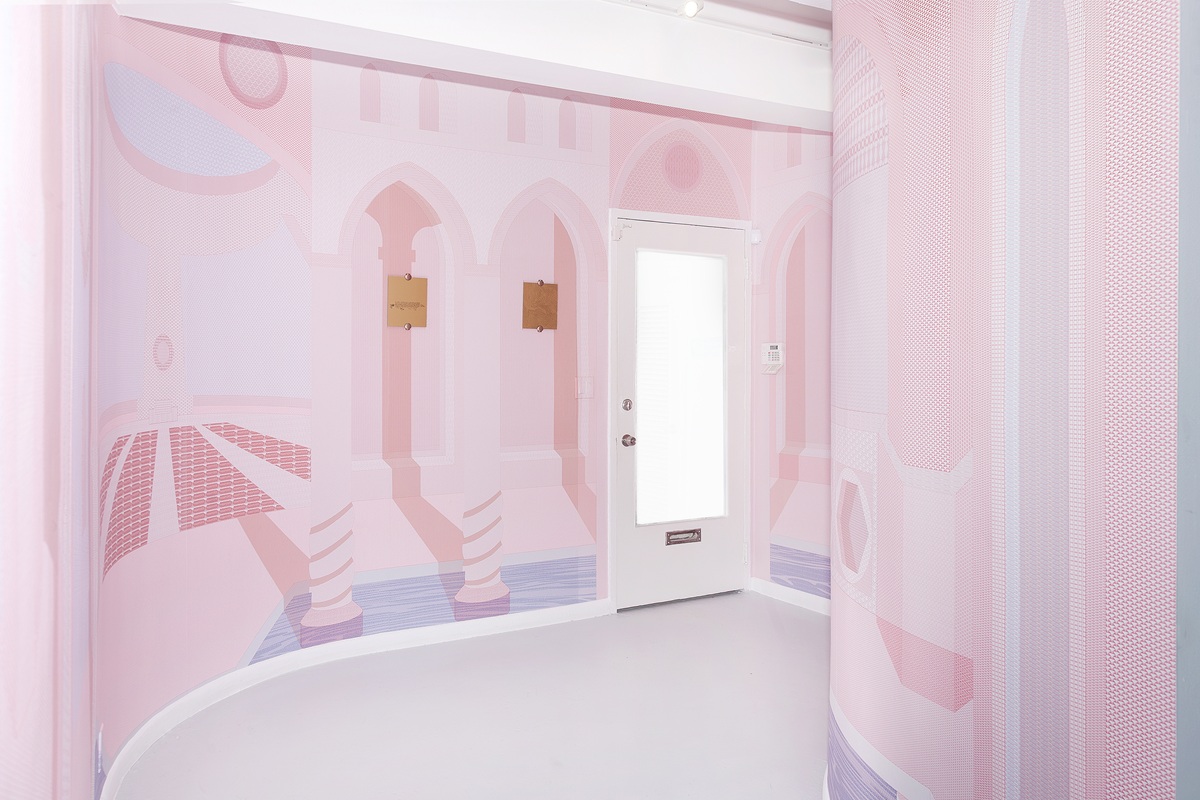
Ana Mosquera transforms the gallery architecture in Vigil with an immersive, hand-drawn environment inspired by the Palacio de las Academias in Caracas, creating a space where personal memory, family history, and Venezuela’s political past converge. (Photo courtesy of the artist)
At first, Ana Mosquera’s “Vigil” seems impossibly delicate.
The curved entrance walls at Oolite Arts are enveloped in pale pinks, muted reds and cool blues. Arches rise across the architecture. Columns, patterned surfaces and imagined passageways turn the gallery into something resembling a temple, civic building or ceremonial chamber. Look closer, however, and the decorative surfaces begin to reveal a considerably more bureaucratic origin.
Mosquera built this environment from the security patterns embedded in passports, visas and residency documents—the nearly invisible designs intended to establish that a document, and by extension the person carrying it, is legitimate.
“I collected the patterns from 10 years of documents,” says Mosquera during a studio visit. “There were 100 patterns, and they’re all here.”
That act of extraction and redrawing forms the foundation of “Vigil,” Mosquera’s installation in “Sites of the Self,” Oolite Arts’ annual resident exhibition, curated by René Morales and on view through Sunday, Oct. 4. Spanning approximately 65 feet across the exhibition’s curved entrance walls, the installation incorporates digital drawing, prints, a pen-plotter drawing and an interactive website.
But its real subject is less the passport than the fragile relationship between a human being and the institutions empowered to recognize them.
“What happens when the system that is there to recognize you and give you an institutional identity fails?” Mosquera asks. “How do you continue after that failure?”
For Mosquera, who was born in Caracas and now lives in Miami, that question isn’t theoretical.
She describes spending six years unable to renew her Venezuelan passport after diplomatic relations deteriorated between Venezuela and the United States. Her body, of course, continued moving through the world. Institutionally, however, movement became something else.
“You keep breathing, moving, making your life,” she says, “but you can’t do anything else.”
That contradiction gives Vigil its tension. The installation is visually seductive, even soothing, while its source material belongs to systems of verification, surveillance and control.
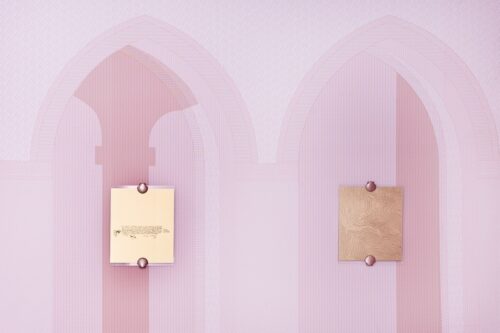
Archival documents are mounted within Ana Mosquera’s intricately patterned reconstruction of the Palacio de las Academias in Vigil. The installation draws connections between the artist’s family history and Venezuela’s larger political and economic history. (Photo courtesy of the artist)
Security patterns are normally designed to disappear into documents. Mosquera makes them monumental.
Some derive from guilloché, the intricate interlocking lines historically used in currency and official papers. Others carry national imagery. Mosquera painstakingly studies their geometries and reconstructs them because the technologies used to produce them are intentionally inaccessible.
There is something mischievous about the process.
Mosquera describes herself as becoming “almost like a counterfeiter,” moving from document to document, deciphering patterns and figuring out how to redraw them.
Yet she isn’t manufacturing a false passport. She is stripping the state’s visual language from its original function and asking what happens when an individual takes possession of it.
That transformation is particularly effective because Vigil doesn’t resemble an immigration office. Its architecture borrows from temples, churches, and institutional buildings.
Mosquera’s architectural training—she earned a degree in architecture at Universidad Central de Venezuela before completing an MFA in sculpture at Tyler School of Art and Architecture at Philadelphia’s Temple University —shapes the installation’s spatial logic. During the studio visit, she traces a connection between religious and governmental systems: institutions change over centuries, she observes, yet many of the structures through which society establishes authority and legitimacy are inherited from earlier religious forms.
The gallery becomes both sanctuary and checkpoint.
Small objects interrupt the vast patterned architecture. Among them are prints made on gold scratch-off paper depicting the topography of the Caracas valley and a centuries-old baptismal record Mosquera discovered while researching her family history.
That baptismal record opened another route into the work.
The document described a child as “illegitimate” and identified the place associated with the record as Tierra Quemada—“burned land.” Mosquera became fascinated by the double exclusion embedded in the language: a person positioned outside an accepted familial structure and connected to a place that itself lay outside an officially recognized geography.
While searching further, she discovered women in her own family recorded as hijas naturales, or “natural daughters.”
What disturbed her was the endurance of those classifications.
Her ancestors were gone, but the documents remained.
“The record continues to exist even though the body isn’t there,” Mosquera says, noting that it could continue assigning a judgment to someone long after death.
By printing these records on scratch-off material—the stuff of lotteries and chance—Mosquera introduces a sharp irony. Birthplace, citizenship, parentage, and access to documentation can profoundly determine a person’s possibilities, yet none are circumstances an individual chooses.
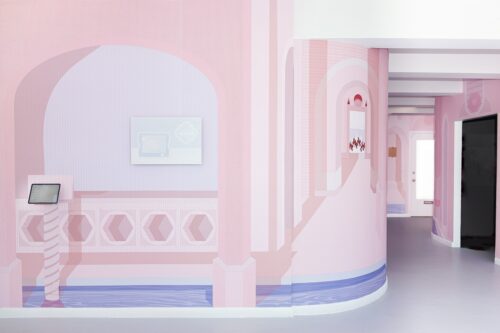
In “Vigil,” Ana Mosquera brings archival imagery, architectural drawing, and digital technology into a single immersive environment, collapsing distinctions among historical record, personal memory, and the present. (Photo courtesy of the artist)
Elsewhere, technology pushes that inquiry toward the present. An interactive component allows visitors to manipulate curves and generate personalized security patterns based on their responses. The viewer is no longer simply looking at the state’s visual apparatus but participating in the creation of another system of identification.
Mosquera is careful, however, not to propose that society can simply abandon documentation. Passports, identification numbers and institutional records provide access to rights and services precisely because societies require systems capable of recognizing people.
Her question is more difficult.
“Is it the best system?” she asks. “There’s nothing else available.”
That ambiguity keeps “Vigil” from settling into a straightforward critique of bureaucracy. Mosquera is interested instead in what comes afterward: how people operate within structures they need but that can also exclude them, and how identity survives when the machinery responsible for certifying it breaks down.
The installation makes that paradox physical.
Visitors enter “Sites of the Self” by walking through Mosquera’s invented architecture, surrounded by patterns once designed to determine authenticity. Here, however, they have escaped the passport. They have become walls, arches, lines and pathways.
The institution’s private language has been expanded so that everyone can see it.
And the person who once needed to prove herself to the system has become the one redrawing its boundaries.
WHAT: “Vigil,” an installation by Ana Mosquera, part of “Sites of the Self,” curated by René Morales
WHERE: Oolite Arts, 924 Lincoln Road, Miami Beach
WHEN: noon to 5 p.m., Monday through Sunday. Through Sunday, Oct. 4, 2026
COST: Free
INFORMATION: (305) 674-8278 and oolitearts.org/
ArtburstMiami.com is a nonprofit media source for the arts featuring fresh and original stories by writers dedicated to theater, dance, visual arts, film, music, and more. Don’t miss a story at www.artburstmiami.com.