
Artburst Extras
AES brings graffiti spirit indoors in ‘Partners in Crime’ at Central Command
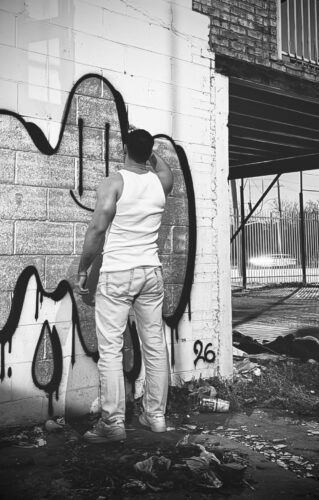
Miami-based artist AES (“The Miracle Ghost”) paints one of his signature ghost figures during a graffiti mission. For AES, street painting remains inseparable from his studio practice, with every work in “Partners in Crime” drawing on decades of shared experiences, camaraderie, and Miami’s evolving graffiti culture. (Photo courtesy of AES.)
A ghost appears repeatedly in the world of Miami artist AES.
Sometimes it is reduced to a few economical black lines: rounded, almost cartoonlike, with dripping edges and two vertical marks suggesting eyes. Its simplicity is deceptive. The figure carries the visual immediacy of graffiti—a mark designed to be recognized quickly—but in AES’ hands, “The Miracle Ghost” has traveled beyond the wall into paintings, mixed-media works and sculpture.
That movement from street to gallery anchors “Partners in Crime,” AES’ solo exhibition at Central Command Gallery in Allapattah, on view through Saturday, Aug. 1.
For AES, who is known professionally by his graffiti moniker and did not want to disclose his legal name for this story, the gallery work grows directly from the experiences, risks and relationships that shaped him as a graffiti writer.
“You don’t lose that,” AES says of graffiti’s hold on his practice. “When you fall in love with graffiti … you just keep doing it. There’s no stopping.”
That persistence helps explain the exhibition’s title.
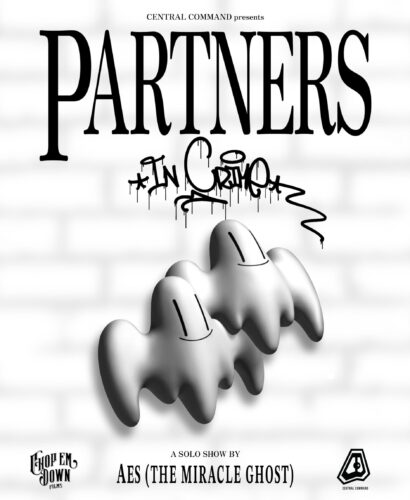
“Partners in Crime, “a solo exhibition by Miami graffiti artist AES (“The Miracle Ghost”), opened July 25 at Central Command Gallery in Allapattah. The exhibition celebrates friendship, trust, and the collaborative spirit at the heart of Miami’s graffiti and hip-hop culture. (Image courtesy of AES.)
“Partners in crime” refers not simply to collaborators, but to the people who stood beside AES throughout years of making art—friends who painted with him, watched his back, shared adventures and helped transform an individual act into a collective experience.
“I guess everybody that has come across in my life,” AES says, before narrowing the definition to “the people that have been next to me throughout my journey as a graffiti writer and as an artist.”
From the Wall to the Gallery
The ghost itself becomes an important bridge between those worlds.
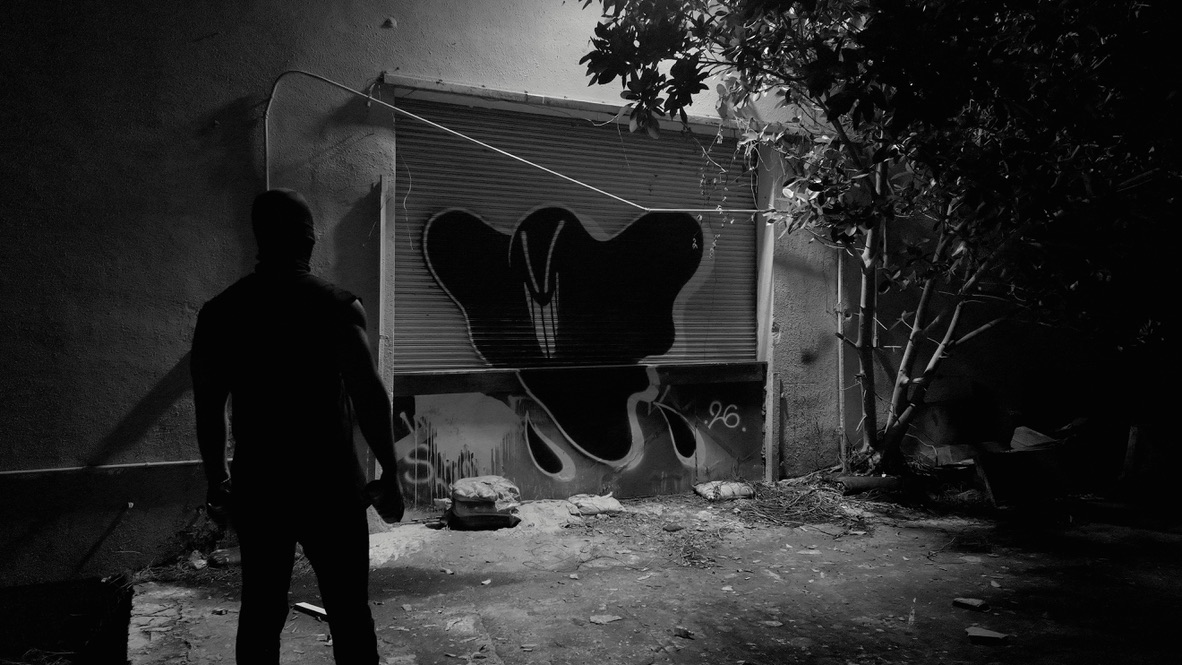
In photographs documenting AES at work, the character stretches across concrete and corrugated surfaces with dripping black contours. The surrounding environment matters: cracked walls, discarded objects, industrial architecture, and the darkness of nighttime become part of the image.
Inside the gallery, that vocabulary is reconsidered through paintings, mixed media and sculptural objects. What was once encountered fleetingly on a wall can now be examined at length.
“There are definitely elements of nostalgia,” AES says. “Every piece has something from those adventures.”
“Partners in Crime” isn’t simply graffiti transplanted into a white cube. AES is translating a culture built around movement, improvisation and impermanence into objects meant to remain.
The exhibition’s emphasis on memory also complicates the bravado often associated with graffiti. Behind the adrenaline is intimacy.
AES describes the culture through trust: knowing who is beside you, understanding one another without explanation and recognizing that what appears to outsiders as an individual signature frequently emerges from collective effort.
“It’s teamwork,” he says. “One hand washes the other, and both hands wash the face.”
Finding Space in Allapattah
That sense of collaboration makes Central Command Gallery more than a backdrop for the exhibition.
Its founder, Louie “Lou” Caceres, comes from the same cultural ecosystem the gallery seeks to represent. With decades of involvement in breakdancing and graffiti, he describes Central Command as a home for artists whose work may be considered too raw for more conventional commercial spaces.
“We focus on artists that are urban,” he says, including artists who “might not fit into blue-chip galleries because they’re too raw or have too much of an edge.”
Wynwood once offered graffiti writers an industrial landscape of warehouses and walls. Its eventual emergence as an international arts and entertainment destination gave street art unprecedented visibility while simultaneously changing the environment that helped produce it.
AES doesn’t romanticize that transformation.
“Wynwood has definitely been gentrified,” he says. “It’s not even the shadow of what it used to be.”
What he misses is succinct: “The rawness … that was its identity.”
A solitary figure approaches one of AES’s signature ghost characters under the cover of night. The photograph evokes the atmosphere of the late-night graffiti missions that inspired “Partners in Crime,”where trust, collaboration, and the unwritten codes of the street become central themes of the exhibition. (Photo courtesy of AES.)
Allapattah provides a different context. Central Command sits within a neighborhood increasingly associated with contemporary art but still marked by industrial and working-class activity. For AES, its character feels appropriate.
“It’s perfect,” he says. “It’s what we’re looking for.”
Central Command’s challenge, then, is not simply to exhibit street-influenced art but to provide a gallery context without sanding away what made that work compelling in the first place.
Caceres sees himself as a connector—“the thread” between the street and exhibition space.
More Than a Solo Show
That philosophy explains why “Partners in Crime” expands beyond objects hanging on walls.
Created in collaboration with Los Angeles-based Chop’em Down Films, the project incorporates film documentation of AES’ process and graffiti activity, extending the exhibition’s interest in collaboration into another medium. Rather than functioning as an unrelated addition, the camera records something a finished painting cannot: the circumstances surrounding the act of making.
The exhibition closes on Sunday, Aug. 1 with a B-Boy Jam, bringing dance into the gallery’s orbit and reconnecting graffiti with the broader hip-hop culture from which Central Command draws its identity.
“Behind every adventure, every risk and every triumph is someone who helped make it possible,” AES has said of the project.
The Ghost Remains
There is an appealing contradiction at the center of “Partners in Crime.”
Graffiti is frequently temporary. A wall gets painted over. A building disappears. A neighborhood changes. The people who once gathered there move elsewhere.
AES is making objects that attempt to hold onto something considerably harder to preserve: the relationships surrounding those moments.
That may be where his Miracle Ghost becomes most effective.
The figure is simultaneously present and disappearing, a recognizable outline attached to something inherently elusive. In that sense, it feels appropriate for an artist looking back at a Miami street-art landscape that has changed around him while insisting that its original codes—loyalty, collaboration and trust—remain relevant.
“You have to go,” AES says of the exhibition. “You have to see the work in order to really understand what we’re talking about.”
WHAT: Partners in Crime, a solo exhibition by AES (“The Miracle Ghost”)
WHERE: Central Command Gallery, 1798 NW 20th St., Miami
WHEN: Noon to 9 p.m. Tuesday through Saturday, noon to 6 p.m., Sunday. Through Saturday, Aug. 1, 2026
COST: Free
INFORMATION: (305) 587-8520 and centralcommandmiami.com
ArtburstMiami.com is a nonprofit media source for the arts featuring fresh and original stories by writers dedicated to theater, dance, visual arts, film, music, and more. Don’t miss a story at www.artburstmiami.com.