
Artburst Extras
Tracing Thought: ‘What’s My Line?’ At Miami Beach Regional Library
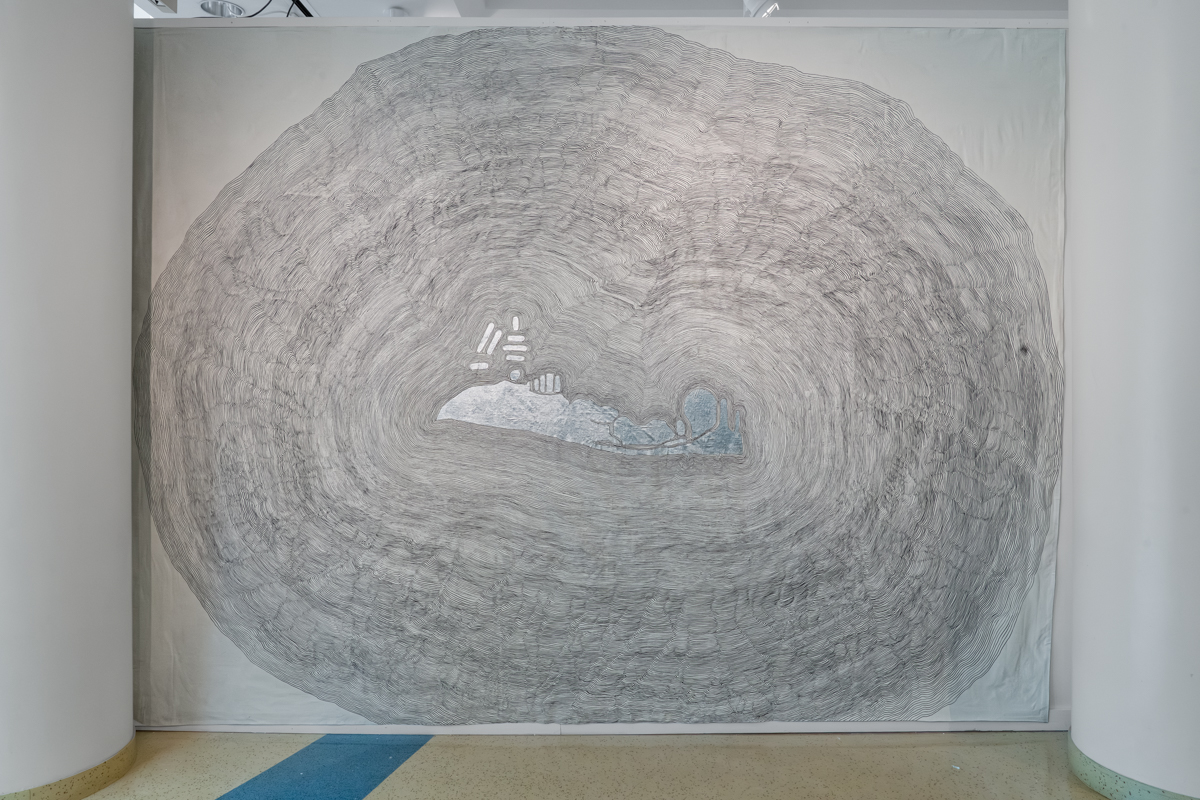
Claudia Vieira’s large-scale drawing installation transforms the gallery wall into a meditative landscape of accumulated lines in “What’s My Line? Drawing as Experience” at the Miami Beach Regional Library. (Photo by Mateo SeZa @mateo.seza, courtesy of Edge Zones)
“What’s My Line? Drawing as Experience” transforms a public civic space into an active conversation about what drawing can be. Curated by Dimitry Saïd Chamy and Charo Oquet and presented by Edge Zones, the group exhibition at the Miami Beach Regional Library on display through Thursday, July 16, features 16 artists whose practices move fluidly across sound, code, fiber, video, printmaking, painting, and installation. Rather than treating drawing as a preparatory medium or static image, the exhibition expands it into something experiential: a trace of thought, movement, memory, and interaction.
The title carries layered meanings. “What’s my line?” references both the familiar phrase of personal identity and the 1950s television game show in which contestants guessed professions through subtle clues and gestures. That association becomes an apt metaphor for the exhibition’s premise. Each artist leaves behind a visual or sonic trace that reveals not simply what they make, but how they think.
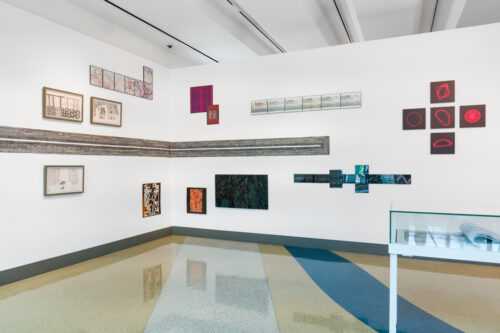
Installation view of “What’s My Line? Drawing as Experience,” presented by Edge Zones and curated by Dimitry Saïd Chamy and Charo Oquet at the Miami Beach Regional Library. The exhibition brings together 16 artists exploring drawing as process, memory, and spatial experience. (Photo by Mateo SeZa @mateo.seza, courtesy of Edge Zones)
The library setting proves unexpectedly ideal. Unlike the white-box neutrality of a traditional gallery, the Miami Beach Regional Library is already a place built around the circulation of language, marks, and ideas. Visitors drift into the exhibition from the surrounding stacks and public spaces, encountering works that ask them to slow down and reconsider the meaning of a line — whether drawn by hand, generated through code, sung as sound, or embedded in systems of migration and surveillance.
One of the exhibition’s most striking gestures greets viewers before they enter the space. Brazilian artist Claudia Vieira’s large-scale, continuous-line mural stretches across the exterior wall like a looping topography of movement and memory. Evoking Miami Beach’s islands and waterways while subtly nodding to Christo and Jeanne-Claude’s “Surrounded Islands,” the work transforms geography into something bodily and intimate.
Inside, the show unfolds less as a fixed thematic statement than as an evolving network of relationships. Chamy’s curatorial approach embraces drawing as a process rather than a product. The exhibition repeatedly asks viewers to reconsider what constitutes a drawing in the first place. That conceptual elasticity is especially evident in the work of Spencer Chang, whose browser-based digital piece visualizes internet activity in real time. Cursors and mouse clicks become abstract constellations of circles and moving lines, exposing the invisible systems of surveillance and data collection embedded in everyday online behavior. What emerges is oddly beautiful: a constantly shifting drawing authored collectively by strangers navigating the web.
Nearby, artist and composer Juraj Kojš transforms drawing into musical notation through colorful graphical scores that blur the boundary between visual art and sonic composition. The works function as visual instructions for live performance, turning lines and geometric forms into rhythm and vibration. Here, drawing becomes temporal and communal — something heard as much as seen.
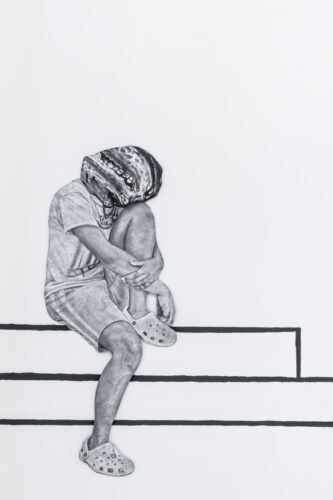
Chris Friday’s “The Stoop” explores solitude and interiority through delicate graphite rendering in “What’s My Line? Drawing as Experience,” curated by Dimitry Saïd Chamy and Charo Oquet at the Miami Beach Regional Library. (Photo by Mateo SeZa @mateo.seza, courtesy of Edge Zones)
Several artists address movement across borders, both literal and psychological. Ana Mosquera’s intricate compositions incorporate patterns derived from passports, visas, and bureaucratic security documents. The resulting abstractions speak quietly but powerfully about migration, legitimacy, and the systems that regulate belonging. Her interactive digital work allows viewers to manipulate approval stamps and immigration imagery before receiving either acceptance or rejection on screen. The experience feels playful at first, until the emotional weight of institutional authority reveals itself.
The exhibition also highlights artists whose work remains more traditionally rooted in draftsmanship while still expanding drawing’s possibilities. Chris Friday’s monumental mural “The Stoop” depicts a figure turned away from the viewer, wrapped in privacy despite occupying public space. Executed with remarkable sensitivity to line and gesture, the work reflects Friday’s ongoing exploration of Black cultural identity and social visibility.
Meanwhile, Viera’s sprawling carbon-drawing stretches nearly the length of the gallery. Created on delicate Japanese paper using discarded carbon material, the work evokes both environmental fragility and the accumulated traces of urban life. The piece anchors the room physically while reinforcing the exhibition’s larger meditation on process and residue.
Digital and technology-based works appear throughout the exhibition, yet they remain deeply connected to human experience, perception, and interaction. Felice Grodin contributes an augmented reality work that allows viewers to summon virtual sculptural forms on their phones. At the same time, Richard Garet’s hypnotic digital installation transforms light itself into a continuously evolving line-based environment. Even with these technologically driven works, a tactile and human quality is retained, emphasizing perception and participation over spectacle.
Elsewhere, artists such as Carola Bravo, Pablo Matute, Owen Roberts, Judith Robertson, Sterling Rook, Laurencia Strauss, Alba Triana, and Tom Virgin contribute works that collectively expand drawing beyond any singular medium or definition. Some focus on gesture and abstraction, others on systems, architecture, or language, yet together they reinforce the exhibition’s central premise: that drawing is less about representation than about the act of tracing experience itself.
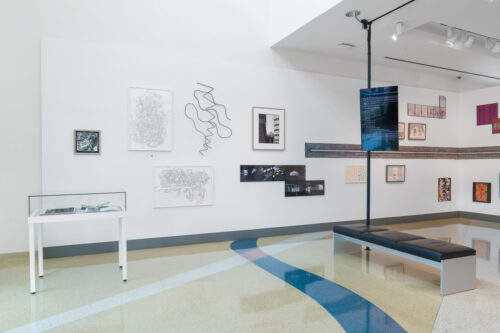
Installation view of “What’s My Line? Drawing as Experience” at the Miami Beach Regional Library, featuring works that expand drawing into sound, digital media, abstraction, and conceptual mapping. (Photo by Mateo SeZa @mateo.seza, courtesy of Edge Zones)
One of the exhibition’s greatest strengths lies in its refusal to separate analog and digital practices into opposing categories. Instead, “What’s My Line?” proposes that all drawing — whether created through pencil, code, sound, projection or movement — originates from the same impulse: the desire to leave evidence of experience behind.
The exhibition also quietly champions Miami’s creative ecosystem. Many participating artists maintain deep ties to South Florida through institutions such as Florida International University, experimental artist-run spaces, and interdisciplinary collaborations that continue shaping the region’s cultural landscape. Chamy and Oquet foreground this interconnected community without turning the exhibition into a purely regional survey. The result feels expansive rather than insular.
In a cultural moment dominated by speed, distraction, and over-explanation, “What’s My Line? Drawing as Experience” offers something more contemplative. It asks viewers to pay attention to marks that might otherwise go unnoticed — a cursor’s movement, a hand-drawn score, a repeated gesture, a traced memory.
At its core, the exhibition maintains that drawing is not merely an artistic discipline but a way of thinking through the world. These artists follow lines not toward certainty, but toward discovery. And in doing so, they invite viewers to do the same.
WHAT: “What’s My Line? Drawing as Experience”
WHERE: Miami Beach Regional Library, 227 22nd St., Miami Beach
WHEN: 9:30 a.m. to 8 p.m., Monday through Saturday. Closed Sunday, Through Thursday, July 16.
COST: Free
INFORMATION: (305) 535-4219 and mdpls.org/branch-miami-beach-regional
ArtburstMiami.com is a nonprofit media source for the arts featuring fresh and original stories by writers dedicated to theater, dance, visual arts, film, music, and more. Don’t miss a story at www.artburstmiami.com.