
Artburst Extras
Little Haiti Book Festival Continues Its Evolution of Representation
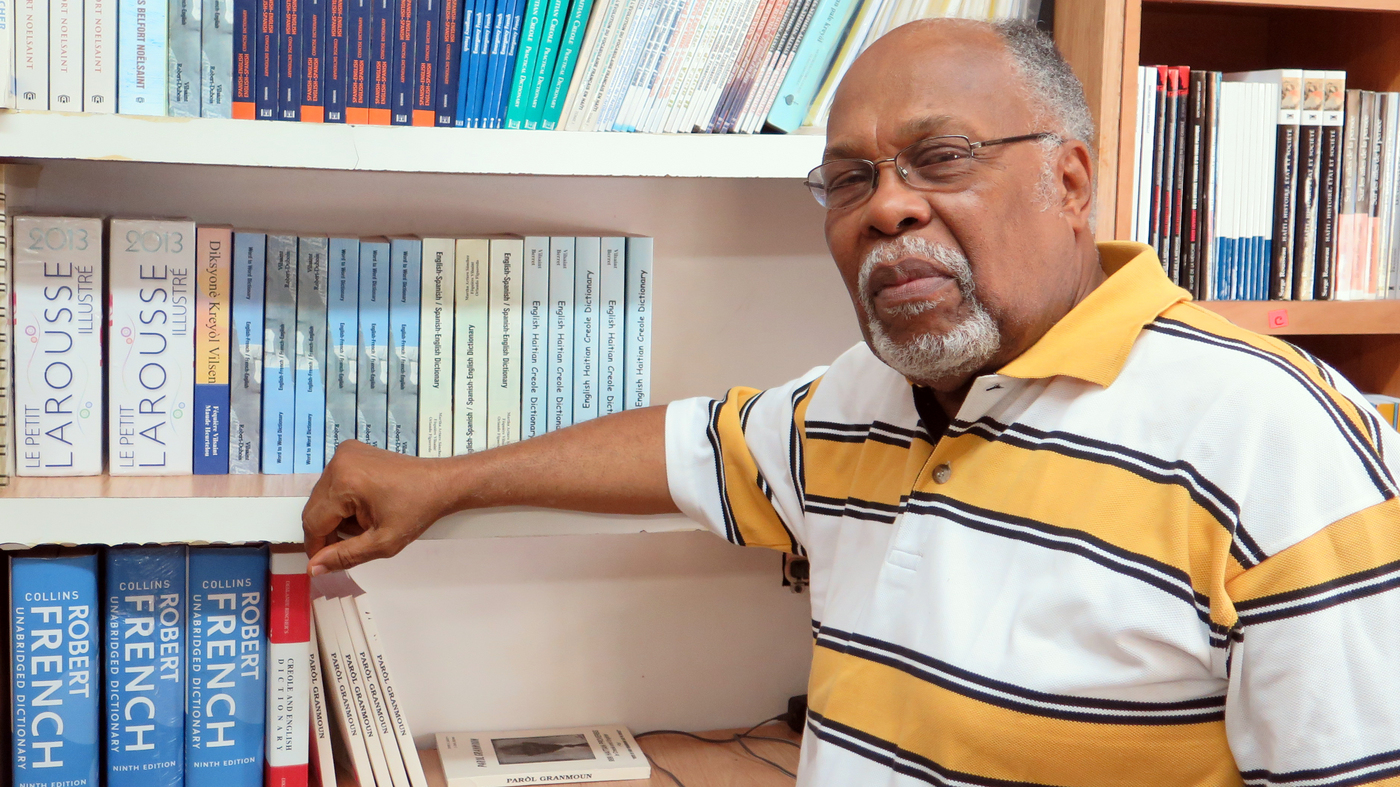
Jean-Marie Willer Denis, known as Jean Mapou in the Haitian community, co-founded the Little Haiti Book Festival in 2012 with Sosyete Koukouy to create a platform for Haitian writers to present and sell their books. This year’s festival is Sunday, May 3. (Photo courtesy of Little Haiti Book Festival)
South Florida is home to about 130,000 people born in Haiti and nearly 300,000 of Haitian descent. But just being visible in Miami doesn’t guarantee understanding.
That’s where the Little Haiti Book Festival comes in.
Now in its 14th year, the Little Haiti Book Festival on Sunday, May 3, has grown from a small gathering of about a dozen authors into an established cultural event in South Florida. It attracts between 2,000 and 5,000 attendees each year, according to the organizers.
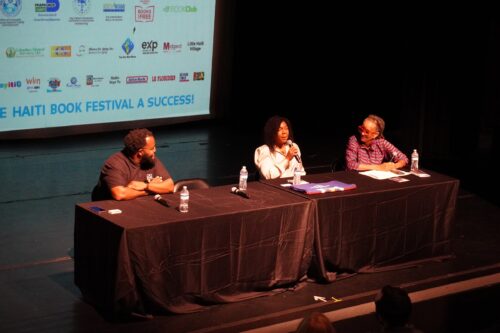
A 2024 panel on the future of Little Haiti featured Abraham Metellus, left, and Joann Milord, center, with François Alexandre not pictured, moderated by Leonie Hermantin, right. This year’s discussions will address Haiti’s contributions to world history, Haitian proverbs as a living philosophical tradition, entrepreneurship, and artificial intelligence. (Photo courtesy of Little Haiti Book Festival)
The book fair, which this year is a partnership of Miami Book Fair and Sosyete Koukouy (literally Fireflies Society), a nearly 60-year-old multidisciplinary arts organization dedicated to the preservation and promotion of Haitian culture, language, and traditions.
The book fair provides a platform for the Haitian community to express its identity through art, literature, oral tradition, music, and education, rather than through outside stories focused on crisis.
We were very intentional about creating a space that feels both grounding and expansive,” says Michele Jessica (“M.J. Fievre”) Logan, coordinator of ReadCaribbean and a Miami Book Fair representative at the festival.
“Grounding, in the sense that people can come and feel seen, connected, and rooted in culture. Expansive, in that we are also creating opportunities to reshape the narrative, to move beyond crisis-driven representations and highlight history, creativity, resilience, and intellectual contributions.”
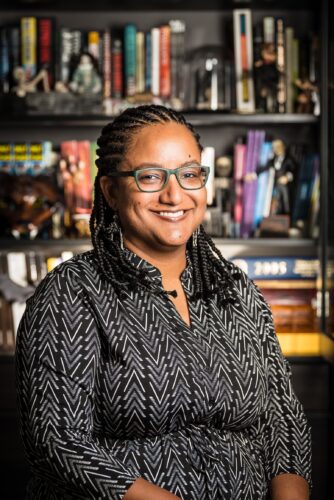
Michele Jessica (“M.J. Fievre”) Logan serves as coordinator of ReadCaribbean and represents Miami Book Fair at the Little Haiti Book Festival. (Photo by RGphotoz, courtesy of Little Haiti Book Festival)
While Haitian culture is highly present – Haitian Creole is Florida’ third most spoken language, Logan points out that the visibility coexists with misunderstanding.
“. . . Especially when the community is discussed mainly through immigration policy, TPS, crisis, or hardship instead of its intellectual, artistic, and historical contributions,” she says
Jean-Marie Willer Denis, known throughout the Haitian community as Jean Mapou, understands this dynamic well. He founded Libreri Mapou, the Little Haiti bookstore he opened in 1990, and is also one of the festival’s founders.
His story is simple. He watched readership decline in the Haitian community and wondered why writers kept producing books. The answer he found changed his perspective. “Authors do not mind continuing to produce books despite the decline in readership,” Mapou says. “They feel they have something inside them that they need to share with the public, whether in science, poetry, literature, or other fields. They believe they have a story to tell, either from their own lives or their surroundings.”
That’s when Mapou says he came up with the idea of a book festival to help authors promote and sell their work.
He looked to the Miami Book Fair, which he had attended since its early days, as a model for what he wanted his festival to be like.
What started in 2012 as a small gathering with more music and arts and crafts than book signings has grown into a full-day cultural event with discussion panels, children’s programming, culinary tents, fashion presentations, and, this year, an expanded outdoor space called Lakou, next to the Cultural Complex.
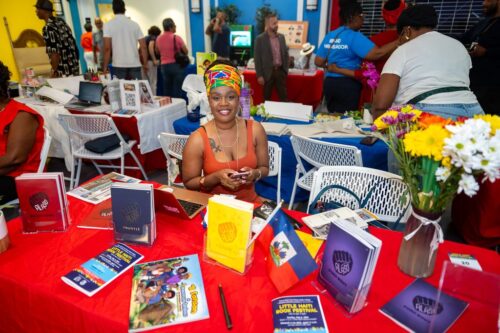
Pascale Solages, co-founder and general coordinator of a Haitian feminist organization, is pictured here presenting a book published by her organization during the 2024 Little Haiti Book Festival. (Photo courtesy of Little Haiti Book Festival)
This year, 80 writers have already signed up to participate, with more expected, and topics that reflect a forward-moving landscape.
“We even have a book on Artificial Intelligence by a young Haitian author, along with a panel discussion on the topic,” Mapou notes. “The world evolves, and so do writers.”
But Mapou is open about his anxiety for this year’s festival. “I’m concerned that immigration issues, the economy, and global conflicts may affect attendance,” he says. “Some people go out less now due to immigration worries, whether they are fully documented or not.”
The festival’s programming emphasizes culture, ideas, and exchange, particularly through discussion panels. Those panels are important, Mapou says, because “it is necessary to provide activities that engage people throughout the day,” and “the topics we discuss are relevant to the community, and people need to hear about them.”
Last year, panelists discussed immigration issues and gentrification in Little Haiti. This year, they will focus on Haiti’s contributions to world history, on Haitian proverbs as a living philosophical tradition, on entrepreneurship, and artificial intelligence.
A discussion called “Haiti’s Historical Contributions in the Making of America and the World” will challenge mainstream narratives by emphasizing Haiti’s vital role in global history. This includes Haitian soldiers who fought in the American Revolutionary War in Savannah, Georgia, and the impact of the Haitian Revolution in prompting Napoleon to sell the Louisiana Territory to the United States, effectively doubling the young nation’s size.
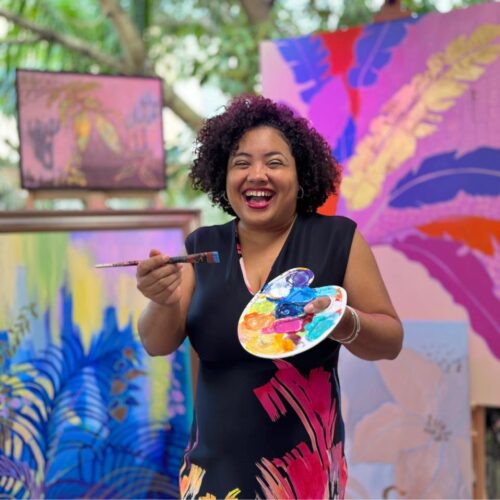
Annick Duvivier, a Haitian multidisciplinary visual artist will read her book “James and Marie Become Friends” in the Children’s Alley during the Storytime session. (Photo courtesy of the author)
The panel “Pawòl Granmoun” (Words of the Wise), organized in collaboration with the Haitian Creole Academy, will bring together scholars and community voices to examine Haitian proverbs as philosophy, ethics, and practical wisdom. Among the speakers at the panel are Rosilia François Corneille, president of the Haitian Creole Academy, and Mingolove Romain, host of one of the few Haitian poetry podcasts in Miami called “Tout est Poésie” (Everything is Poetry).
“Oral tradition is foundational to Haitian culture,” Logan says. “It carries history, philosophy, humor, and collective memory in ways that written text alone cannot. A book festival should reflect that full spectrum.”
That scope also inspires participating writers. Marie Ketsia Theodore-Pharel, author of the bilingual children’s book “I’ll Make Tea, Eritaj grann,” writes for both children and adults. She sees the festival as a vital support for Haitian literary culture. “The Little Haiti Book Festival gives me a loudspeaker to express my little immigrant voice and cut through the fog of negativity that surrounds my culture and identity,” she says. “I use it to say, we (Haitians) are here; we matter.”
Annick Duvivier, a Haitian multidisciplinary visual artist who will read her book “James and Marie Become Friends” in the Children’s Alley during the Storytime session, turned to children’s literature inspired by her daughter’s questions about Haiti. “I realized how precious it is to preserve and share the joyful memories, traditions, and language of Haitian culture,” Duvivier says, “because if they aren’t passed down, they are lost.” Her book, written in both English and Haitian Creole, follows two children, a Black Haitian girl and a white American boy, as they navigate friendship across cultural differences.
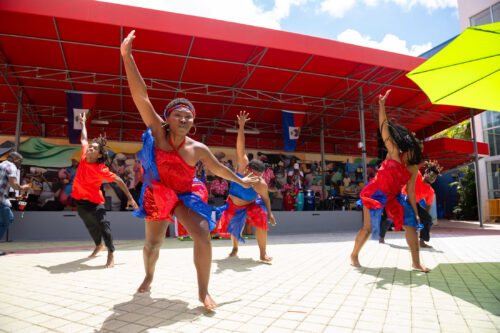
Music and dance remain central to the Little Haiti Book Festival. This year’s program includes live music, along with dance performances and workshops. (Photo by RGphotoz, courtesy of Little Haiti Book Festival)
Marie Ketsia Theodore-Pharel and Annick Duvivier will join Liliane Nérette Louis in the Children’s Alley to read stories to children, reinforcing the festival’s emphasis on programming for young people and families.
“If we are not actively creating pathways for young people to see themselves as storytellers, then we are not sustaining the culture. This year’s youth programming is designed to engage and empower,” Logan explains. Young participants will experience storytelling through rhythm and drumming while taking part in hands-on activities meant to inspire curiosity, self-expression, and a love of reading. Free books for children will be distributed throughout the day.
The festival also reflects a broader understanding of storytelling across different disciplines. This year’s introduction of the Land & Sea Discovery Lab, developed with Frost Science and HistoryMiami, brings science into the cultural framework. “The inclusion of science shows our belief that learning is interconnected,” Logan says. “It connects science to story and place to identity.”
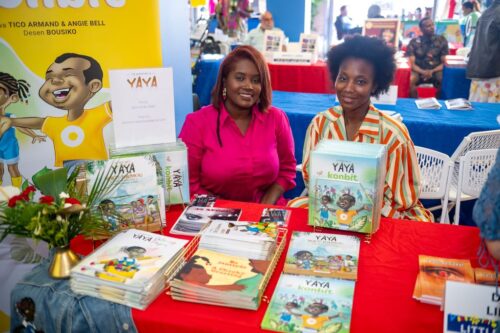
Eighty writers have already registered for this year’s Little Haiti Book Festival, with more participants expected, according to organizers. Angie Bell and Tico Armand, co-authors of “The Adventures of Yaya,” are pictured here during a previous edition of the festival. (Photo courtesy of Little Haiti Book Festival)
A marketplace featuring local vendors and a session on Haitian entrepreneurship with Phelicia Dell and Delphine Nephtalie Dauphin highlight the link between cultural expression and business growth. “Cultural expression and economic empowerment are deeply connected,” Logan states. “The festival creates a culturally specific space where Haitian and Caribbean creativity is treated as economic value.”
As the festival continues to grow, its main purpose remains. It aims to create a space where Haitian voices are heard, where culture is not reduced to crisis, and where community stories are reclaimed. “We are still committed to writers and readers, but we are equally focused on honoring the full range of how culture is expressed, shared, and passed on,” Logan concludes.
WHAT: Little Haiti Book Festival
WHERE: Little Haiti Cultural Complex, 212 NE 59th Terrace, Miami
WHEN: 11 a.m. to 6 p.m., Sunday, May 3 (in-person), and Sunday, May 17 (online)
COST: Free
INFORMATION: (305) 757-9922 or Little Haiti Book Festival
ArtburstMiami.com is a nonprofit media source for the arts featuring fresh and original stories by writers dedicated to theater, dance, visual arts, film, music and more. Don’t miss a story at www.artburstmiami.com