
Theater / Film
Miami New Drama Revisits Miami’s ‘English Only’ Fight Over Spanish

René Granado in a scene from Miami New Drama’s “English Only,” an original play having its world premiere at at the Colony Theatre, Miami Beach.(Photo by Morgan Sophia Photography)
Miami New Drama will premiere its second collaboration with journalist-author-turned playwright Nicholas Griffin with “English Only.” Directed by New York–based director Margot Bordelon, the production takes on one of Miami’s most fraught political battles — the fight over language and power that followed the Mariel Boatlift.
“English Only” runs Thursday, Jan 29 through Sunday, Feb. 22 at the Colony Theatre in Miami Beach.
Set in 1980, the play is rooted in the turbulent months after more than 125,000 Cuban refugees arrived in South Florida. Pushes for the Spanish speakers to adopt English only as their language gained traction nationwide. Citizens of Dade soon followed, organizing an English-only campaign aimed at dismantling Miami-Dade’s bilingual policies.
The proposed changes called for eliminating Spanish from government documents, public communications, and civic life threatening to redraw who held power in a city shaped by immigration. Opposing the effort was Manny Diaz, then a young attorney with the Spanish American League Against Discrimination (SALAD) who framed the language fight as a civil rights issue with lasting consequences for Miami’s identity.
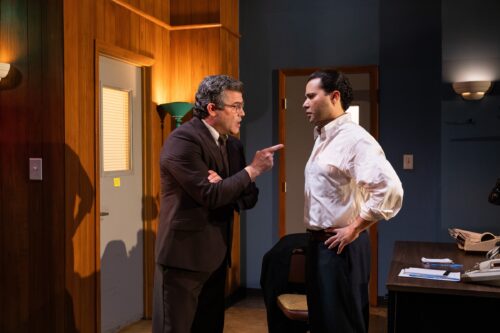
Andhy Mendez as Manny Diaz, left, has words with René Granado,in Nicholas Griffin’s world premiere of “English Only” (Photo by Morgan Sophia Photography)
For Griffin, the writing of “English Only” began soon after his first partnership with Miami New Drama Artistic Director Michel Hausmann. Griffin’s book, “The Year of Dangerous Day: Riots, Refugees, and Cocaine” about Miami in 1980 seemed ripe for a stage adaption.
Griffin arrived in Miami to research the book with his Venezuelan-born wife, Adriana, and their two children, 11 years before it was published in 2020. He sold the screen and television rights, unaware that stage rights had also been included. So when Hausmann first approached him about adapting “Dangerous Days,” Griffin declined. Once he realized the stage rights were available, he quickly changed his mind. The result was the world premiere of “Dangerous Days,” drawn from the book’s deep dive into Miami’s McDuffie riots, which opened at Miami New Drama in April 2024.
“I guess towards the end of ‘Dangerous Days’ Michel said he wanted to do something together again, and he pointed towards a paragraph in the book, recalls Griffin.“It was a paragraph about Emmy Schaefer and the English only campaign. It was merely a paragraph in the book; Griffin said that he had more material that got left on the cutting room floor.
“The editor had whittled that down and there had been many more pages, so I knew quite a bit about it. We started talking about it, and Michel was adamant that he thought there was a play there.”
Hausmann saw not just a historical episode, but a way to talk about the present. “We’re really telling the story of 1980 with the mirror to 2026,” he says. “It’s impossible not to. Maybe had we done this play in 2015 it would have read completely different. Hopefully in 10 years, this is not an issue we have anymore, but it sure as hell is an issue we have right now.”

Playwright Nicolas Griffin with Stacey Mindich, co-chair of the Miami New Drama board talk during “English Only’s” first rehearsal. (Photo by Morgan Sophia Photography)
Griffin had originally met and interviewed Diaz for the book. “And so I went back to him again and Michel joined me the second time around and we had a long lunch digging up stories about him and Emmy Schaefer,” he says, “and how virulent things had been during those months between the two communities”
He did not have a chance to speak with Schaefer. “From what I could gather she is in a memory care facility in Central Florida and is 98 years old.”
Hausmann says talks went on about the play. “This all began before Trump won again,” he says. But then there was the timeliness of it, the urgency. “It became more evident in this anti immigration, this sort of nativism that we’ve had for the past year. I pushed faster its development.”
The play is anchored in a city whose past is often quickly forgotten and Hausmann says that’s why these stories belong onstage. He points to Miami New Drama’s Miami History series, which includes projects like “Elián,” “Dangerous Days,” and “Confessions of a Cocaine Cowboy.”
“Even when we were doing ‘Dangerous Days’ about the McDuffie riot, which was sort of like the event of the decade, very few people had any idea what all that was. We’d go to schools, or we’d go to the teachers — they had no idea. Even Elián, which I think was such a pivotal moment in American history, many people didn’t know about Elián González. We have that extra responsibility in a city, in a community that has very little institutional memory, that we have to be the ones to bring it, to help craft that community collective memory.”
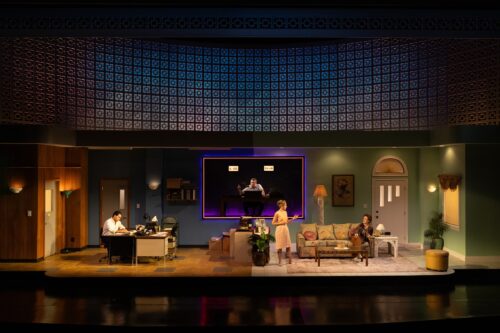
The cast of Miami New Drama’s world premiere of Nicholas Griffin’s “English Only.” (Photo by Morgan Sophia Photography)
In “English Only,” that memory takes the form of a political battle with real stakes. “Within the play, it’s basically the battle of whether she can or can’t raise her 25,000 signatures to get the English only ordinance on the ballot,” explains Griffin. “She does it. She actually gets, I think, 147,000, so it was remarkably oversubscribed. She just tapped into something no one even knew existed in America at that point, this huge resentment against an immigrant community.”
That November, when it goes on the ballot, Schaefer wins easily.
“Emmy Schaefer gets almost 60 percent of the vote, and that means that the original ordinance for Miami-Dade being a bilingual county is rescinded, and for 13 years we are not a bilingual county. It’s not until 1993 that we flip back again,” says Griffin.
Griffin also draws a through-line from Schaefer’s campaign to later efforts to defend bilingualism. “That was interesting later on,” he says. “SALAD, who are represented in the play as, you know, the sort of flip side of Emmy Schaefer’s Citizens of Dade United, they then come up later on with, instead of English only, they come up with English plus, which was the defense of bilingualism. But obviously, you know, we’re in this unique spot in America here, where the argument, one of the arguments, was: if any city could build its fortune on being bilingual, it should be Miami. And that’s kind of the way things have gone.”
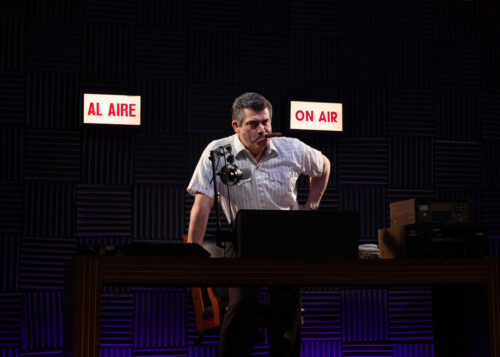
René Granado in a scene from Miami New Drama’s world premiere of “English Only.” (Photo by Morgan Sophia Photography)
For Hausmann, what matters is that the play makes room for those arguments without lecturing the audience. “We’re very careful not to be preachy,” he says. “Both sides of the argument have intellectual merit. Nick allows Emmy Schaefer to give her point of view — ‘I’m an immigrant, I came to this country not knowing English, it was important for me to become part of this country, so I learned English. If I could do it, why can’t you?’ And then you have Manny saying, we’re a nation of immigrants, and Miami was transformed because of bilingualism, not in spite of it. I want the audience to be presented with those arguments and to decide where they stand.”
“English Only” also continues Miami New Drama’s broader commitment to creating new work rather than importing established titles. Over the past decade, the company has developed original plays that have moved to larger stages, including “It’s a Wonderful Life,” which transferred to Broadway and another, “Birthright,” which is headed to MCC Theater in New York with an eye toward a future Broadway run. The company’s trilingual version of “Our Town” is now published and produced nationwide, and “The Cubans” and “7 Deadly Sins” have drawn national attention.
Hausmann says he has little interest in simply remounting proven hits. He sees Miami New Drama as the place where major works begin. “I wouldn’t want a more relaxed life doing repertory of shows that have already been figured out on Broadway,” he says.. “What excites me is that Miami New Drama is the first draft of the next major American work. I like us to be the first, and I think, the most important step in the creation of new work.”
WHAT: World Premiere of Nicholas Griffin’s “English Only”
WHERE: Miami New Drama, The Colony Theatre, 1040 Lincoln Road, Miami Beach
WHEN: 8 p.m. Thursday through Saturday; 3 p.m. Sunday. Through Feb. 22.
COST: $40-$90
INFORMATION: 305-674-1040 and miaminewdrama.org
ArtburstMiami.com is a nonprofit media source for the arts featuring fresh and original stories by writers dedicated to theater, dance, visual arts, film, music and more. Don’t miss a story at www.artburstmiami.com.